Personal Protection Insurance

The most important asset we have to achieve our financial goals is our ability to earn money. If we are unable to work and generate an income, not only would our financial goals be unachievable, our ability to meet everyday costs could be in jeopardy.

Having our Personal Protection Insurances in place is critical in ensuring that our families can continue to be financially secure in the event that we may be unable to work or pass away. Australian Private Capital regularly prepares a Personal Protection Gap Analysis for every client recommending comprehensive cover for financial protection and peace of mind.

Here is a recent story of one of our clients:

……………………………………………………

Just over two years ago, I was surfing with a few friends.

As we headed out to the break in the transfer boat, one of my friends noticed a mole on my right shoulder blade and suggested that I get my brother (who is a surgeon) to take a look at it.

My brother took a biopsy on the Thursday and on the Friday morning whilst at work he called me and asked the time that I had breakfast that morning. He wanted me to have surgery that day.

The surgery to remove what turned out to be a very aggressive melanoma went well and I have made a full recovery but I probably owe my life to my very observant mate and that particular surfing session.

It was during the course of our next Regular Planning Meeting with APC that I mentioned my experience with the melanoma. Luke Price from APC said he thought that I might be eligible to claim on my existing Trauma and Income Protection insurance covers.

It turned out Luke was absolutely right and my claim resulted in an insurance payout soon after.

APC was excellent during this time as they liaised with the insurance provider and I had only a limited involvement in the process. Ultimately the insurance claim payment was deposited in our bank account quite quickly.

Whereas the melanoma brought about an anxious and quite stressful period in our lives, the insurance payout provided added financial security to our family. It was reassuring knowing that the financial side of our lives was taken care of during this period.

It was APC that recommended that we both implement adequate insurance covers in the first place and for this we are now grateful.

As for the Regular Planning Meetings, we appreciate the APC process even more now.  The systematic review of our financial position, including insurance, every six months or so means that we are confident of our financial future.  A regular check of freckles/moles is also a good idea!

Annual Client Survey

Thank you to all our Clients who took the time to complete our online 2016 Annual Client Survey. The results help us plan for future initiatives that help maintain and improve our service to you.

The Results:

We are extremely pleased with the 2016 results which were again well ahead of our national averages. It is important to remember that only the better financial planning practices around Australia participate in this survey.

APC achieved top quartile ratings in 8 of the 9 Key Performance Indicators (KPI’s) and did not underperform the national benchmark in any of these areas.


Category APC Score National Benchmark  Variance
Understanding 4.52 4.27 .25
Business Relationship 4.62 4.46 .16
Financial Knowledge 4.64 4.33 .31
Range of Financial Services 4.37 4.11 .26
Implementation of Solutions 4.48 4.17 .31
Professionalism of Business Practice 4.83 4.38 .45
Standard of Support Staff 4.80 4.35 .45
Financial Review Process 4.56 3.94 .62
Communication 4.52 4.07 .45
Total 4.59 4.19 .40


Where to from here?      

APC has been working on a project over the past year that will enable clients to log on and update their Needs Analysis (personal and financial data) online prior to their Review via our APC Website.

It would also allow clients to access their Advice, Review and other Compliance documents online, at anytime, anywhere in the world.

Currently we are testing this process with some Off-shore clients and we expect to extend it to all clients later in the year.

APC will be surveying some of our younger clients to better understand and meet their product and service requirements. We intend to identify how we can improve our service to this specific and growing demographic.

A Farewell Speech from Michael Tratt

The following is an abbreviation of the opening comments given by Michael to clients at the National Gallery of Victoria on 2 August. …………………………

I’m glad you’re all here because I need to address a rumour going around that I’m going to retire in four weeks’ time. Let me tell all of you the truth that I don’t expect to ever retire. I also don’t expect to arrive in the office on 1 September expecting my desk to still be my desk and everything as it was for the last THIRTY years. For a start, Marie wouldn’t let it. I’ve promised her an easier life and she has a certain way of making sure that what I promise her happens.

What I mean is something different. The word “retirement” does not sit well with me. It conjures up images of me shuffling in slippers waiting for the end. You and I know, I’m not that type of person. What is true is that I’m retiring from work as I’ve known it – the regular round of 9am to 5pm, 5 days a week and beyond. In the same way that we have planned for all of you, we have also planned for Marie and me. Yes, I am retiring from the day to day operations of APC but not from life. I fully intend to go on living.

So from next month, I’ll be starting a new chapter. It will be different but there’ll be much of this one that I’ll carry forward with me. The people I’ve met, the experiences we’ve shared – these are things I’ll remember and cherish. I set up APC in order to make a difference to the lives of those I had the good fortune to have as clients. We have people here tonight who have been clients for almost thirty years of our journey. We have many in attendance tonight who have been clients for over twenty years. There are people here tonight who have known me from my school days and my early working life. To all of you I would like to say thank you for being such an important part of my life’s journey.

I will also never forget the team and the teamwork at APC, and the ups and downs of a thirty year journey. When I began APC there was no real internet, nor websites. There was little automation. What we did over the years, we did together. Without our collective energies, enthusiasm, and will to find new and better solutions, none of the innovations we now take for granted could have happened. To our team: thank-you. I’ve enjoyed being with you and I’m proud of what we’ve done. I know you’ll go on creating, experimenting and moving forward. You can be sure I’ll be eager to follow the changes.

There’s truth in the idiom, ‘nothing ventured, nothing gained’ and we’ve proved it – together. And just for the record, I repeat again, I am not retiring. I’ll be working with just as much energy as ever but on the things I’ve put on hold over the years. There’ll be more time for Marie, our family and our friends, and of course travel…I call that living. I became a grandfather for the first time two weeks ago. This really is the beginning of a new stage of life.

With respect to the future of APC, Rob Sarafov will become a majority shareholder and Hayden Windsor will take up the balance of the APC shareholding. And yes, I will continue to invest my funds in the Classic 100 portfolio. So in conclusion, this is not goodbye, just a change of direction. Thank you all for the richness you have afforded me on my journey.

Thinking Small

Every night on the TV finance news, you’ll hear about the ups and downs of household name stocks, like the big four banks, Telstra, CSL, Wesfarmers, Woolworths, BHP Billiton and Rio Tinto. But the market is more than that handful of names.

There are about 500 stocks in the All Ordinaries index, the indicator often referred to in the media as the benchmark for the Australian share market. The combined market value of all those stocks, as of August 2016, was close to $1.8 trillion.

Large cap stocks, such as the big stocks mentioned above, make up about 80-85% of the total market cap. Currently, these are roughly the largest 100 stocks by size. The remaining 15-20% of the market cap is represented by the small company stocks.

So why would you want to include these often obscure companies in your portfolio? Well, there are a couple of reasons. One is that these stocks (known as ‘small caps’) tend to behave differently to the better known larger names otherwise known as large caps.

Sometimes, large caps will be the best performers. Other times, small caps will be in favour. So owning both parts of the market means you are getting a diversification benefit. In other words, some of the volatility of being exposed to just one part of the market is reduced.

A second reason for owning small caps in a diversified portfolio is that they are expected to earn a premium over large company stocks. Research shows this small cap premium (alongside premiums from low relative price and highly profitable stocks) is persistent across time and pervasive across different markets around the world.

There are a few provisos to this finding. One is that the premiums are not there every day, every month or even every year. While we expect them to be there every day, there are periods when small caps will underperform large caps. This makes sense because if the premium was there all the time, it would be traded away.

A second caution is that within small caps, other premiums are at play. Research shows that among small stocks, those with high relative prices (sometimes known as ‘growth’ stocks) and lower profitability tend to have significantly lower expected returns than the rest. That means we need to take into account this difference in expected returns.

Finally, diversification is critical. Over shorter periods, some stocks may do exceptionally well; others exceptionally poorly. It’s difficult to identify these stocks in advance. And that’s why you need a well-diversified portfolio that can capture the performance of these stocks in a more consistent manner. Diversification also helps control implementation costs which if unmanaged can be quite high for small cap stocks.

So what’s been the long-term evidence of a small cap premium in Australia? Over nearly four decades to the end of 2015, small caps here delivered annualised returns of nearly 14%, beating large caps by around two percentage points per annum on average.1

The tricky thing for investors is the “on average” bit. In some years, such as 1989, small caps significantly underperformed large caps. In other years, such as in 1993, small caps shot the lights out, figuratively speaking.

Indeed, over the four-decade period shown in the chart below, you can see that only in four years has the performance of small cap stocks been within 2% of that average premium. So the small cap premium (the difference between the performance of large and small cap stocks) can be volatile, which is the price you pay for earning the premium.


In recent years, Australian small company stocks have struggled. In fact, in the four years from 2011-2014 inclusive, the small cap premium (as shown above) was negative.

But does that give us any information about the future performance of small cap stocks or what might drive the performance in the years ahead?

In other words, can we time the premiums available from small, low relative price and more profitable stocks? It would be nice, wouldn’t it? But rigorous tests show very limited evidence that we could do so reliably. That’s the bad news.

The good news is you don’t need to be a timing wizard to get the benefit of these premiums. We’ve seen they are there over the long term. And we know that the best way to capture them is to apply a consistent focus within a broadly diversified portfolio.

The nature of the small cap premium, however, is that when it does kick in, it can do so with a vengeance.

And that’s precisely what we have seen in the past 12 months to the end of July 2016 as small caps (as measured by the same index as in the above chart) have delivered a return of about 18% in the Australian market, well north of the flat result from large cap stocks.2

So the big glamour stocks are not all that there is to our market. Small cap stocks also play an important role in your portfolio. They provide a diversification benefit because they behave differently to those big names. But they also offer an expected premium over time.

The trick is riding out the volatility and staying disciplined within the asset allocation of your Classic portfolio.

It’s a small world after all.

Pokémon Investing

Have you noticed the surge recently in people wandering aimlessly and staring at their smartphones? Chances are they’re playing Pokémon GO, the latest craze. It’s an activity eerily close to how some folk see investing.

From Tokyo to Frankfurt and from New York to Sydney, tens of millions of people have become obsessed with finding tiny virtual creatures called Pokémon, using their smartphones’ camera and global positioning systems.

Such is the addictive nature of Pokémon GO that some people have been caught playing the game while driving. Two men in the US were reported to have fallen off a cliff in their search for Pokémon. Others have been hit by cars.1

The blinkered and single-minded behaviour evident in those hunting Pokémon can also be seen in people who build portfolios around individual securities. And while you won’t get run over, you can still do yourself a lot of damage this way.

Stock pickers tend to concentrate their portfolios around what they see as their best ideas. They will focus on stocks which they believe the market has mispriced and buy them in the hope the market will come around to their view eventually.

Of course, there are a few problems with this approach. Like Pokémon players so focused on their phones that they miss a spectacular sunset (or worse lose their jobs!), stock pickers can be so intent on finding the right stock that they overlook the opportunity cost of missing out on the market return.

A narrow focus also leaves the stock hunter open to idiosyncratic risks associated with single companies or sectors, risks that can be offset by keeping your portfolio broadly diversified.

The Pokémon addict who walks in front of a truck is like the stock picker who stakes everything on a security that crashes his portfolio. The risk isn’t just that his stock bets fail to pay off, but that he fails to earn the market returns owed to him and falls short of his medium-term and long-term financial goals.

Another issue is cost. It may be diverting to spend your lunch hour chasing after digital “creatures”, but you could also have spent that time reading or catching up with friends or going to the gym to get healthy. Likewise, stock pickers have to factor in the costs of brokerage, time and stress related to betting against the market.

The question you have to ask is whether the considerable risks you are taking are worth the possible benefit. Keep in mind that surveys consistently show that over time only a small fraction of stock picking managers outperform the market after fees. And even then, it is very difficult to identify the winners in advance.2

As for individual stock recommendations, you don’t have to go far to find examples of investor guidance that turn out to be the share market equivalent of someone following an imagined Pokémon over a cliff.

In March, 2015, one Australian media outlet noted that consumer electronics retailer Dick Smith Holdings Ltd had “jumped to the top of a number of analysts’ buy lists” after it reported strong first half earnings and flagged buoyant sales.3

At that point, the stock was trading at around $2 a share. By the end of that year, it had fallen to 35 cents. In January 2016, the company collapsed and was placed in receivership. All of its 363 stores in Australia and New Zealand were closed and more than two thousand people lost their jobs.

Now, the analyst calls on Dick Smith at the time might have seemed perfectly reasonable given the information to hand. Their perceived “fair price” for the security was well above $2 and this would have been a profitable trade had they been right.

But the analysts turned out to be wrong. Basing investment performance on identifying a “mispriced” security did not work in this case.

In other cases, of course, analysts will have got it right. But a lot of things have to fall into place for this to be a consistently winning strategy. Not only does the market have to come around to your price, you have to ensure that costs don’t outweigh the premium you earn. And even if you meet those requirements, some new piece of information might still move the price in the opposite direction of your forecast.

The fact is prices change as information changes. Unless you have a crystal ball, it seems highly unlikely that you’ll find all the market Pokémon without doing yourself some damage in the process.

A better approach is to work on the basis that current prices are fair. Instead of second guessing prices, you use the information they contain to build highly diversified portfolios that pursue higher expected returns while minimising idiosyncratic risks and avoiding unnecessary costs.

Of course, using this approach does not eliminate risk. And there will be times when you won’t be compensated. But you can be confident that there is a sensible explanation for this way of investing, that the desired premiums are persistent and pervasive and that you can capture them cost effectively.

Pokémon Go is not all bad. But to borrow its slogan, “you gotta catch ’em all”.

Diversification Counts when Uncertainty Beckons

It is a good time to take a simple temperature check.

Pick the option that best describes your attitude to investing today:

A – confident
B – fearful
C – uncertain
D – all of the above

Economic messages and market signals blended with dramatic and tragic geo-political events are presenting investors with lots of conflicting information to digest.

The Brexit vote understandably unsettled markets while the glacial-like counting in our federal election added its own sense of uncertainty. Then came the tragedy and drama of events in France and Turkey over the weekend that added an emotional and human perspective.

Back home a range of research reports made media headlines forecasting falling or flat residential property prices in major cities – the traditional safe harbor of Australian investors.

In the midst of all this an industry colleague was questioning the role of another traditional investing safe harbor – fixed income.

The question is both valid and topical. It is hard to get excited about an investment where return forecasts around the globe are close to zero.

But when information is overloading you with mixed, at times opposing signals – the US sharemarket hit a new record high last week in case you hadn’t noticed – that is as good a time as any to go back to first principles.

Vanguard has enjoyed success in 20 years in the Australian market based on four basic principles that guide the investment approach. Developing a balanced asset allocation using broadly diversified funds is at the heart of the approach.

That importantly incorporates fixed income as a key part of the asset allocation mix.

Vanguard’s Global chief economist Joe Davis wrote in a recent blog that to build a multi-asset-class portfolio appropriate to a given goal and risk preference depends, primarily, on the following three characteristics of each asset:

  • its expected return
  • the expected volatility of those returns
  • the correlation of the asset’s return with those of other assets (i.e., its covariance)

Around the globe yields on government bonds are extremely low. So does that mean investors need to look elsewhere? Return is obviously a key measure of any investment but critically it should not be the only measure.

Why do investors buy US government bonds yielding less than 2 per cent and even with negative yields in other markets? Certainty is the answer. As one wag of a portfolio manager quipped recently – zero is a lot better than minus 20 per cent or 30 per cent.

One of the key principles of diversification is finding assets that are not correlated to other parts of the portfolio. When shares zig bonds usually zag which is the intrinsic value of bond holdings in a portfolio. So for investors bonds are really the defensive side of the equation.

A basic but important factor in building a diversified portfolio is to have assets within it that are not highly correlated and will not move in lockstep with a major asset class like local and international sharemarkets.

Vanguard’s Investment Strategy Group has looked at the correlation levels between 10-year Australian Government bonds and the Australian sharemarket. When you look back to the late 1990s there was a positive correlation between bonds and shares. Since the global financial crisis in 2008 the correlation has remained in negative territory.

So despite the low yields on offer the diversification power of government bonds and fixed income remains as strong as it has ever been.

History on the Run

When news breaks and markets move, content-starved media often invite talking heads to muse on the repercussions. Knowing the difference between this speculative opinion and actual facts can help investors keep their nerve.

At the end of June, UK citizens voted in a referendum for the nation to withdraw from the European Union. The result, which defied the expectations of many, led to market volatility as participants weighed up possible consequences.

Reporting on the result, The Washington Post said the vote had “escalated the risk of global recession, plunged financial markets into freefall and tested the strength of safeguards since the last downturn seven years ago”.1

The Financial Times said ‘Brexit’ had the makings of a global crisis. “(This) represents a wider threat to the global economy and the broader international political system,” the paper said. “The consequences will be felt across the world.”2

Now it is true there have been political repercussions from the Brexit vote. Teresa May replaced David Cameron as Britain’s prime minister and overhauled the cabinet. There are debates in Europe about how the withdrawal will be managed and the possible consequences for other EU members.

But markets have functioned normally. Indeed, within a few weeks of the UK vote, Britain’s top share index, the FTSE 100, hit 11-month highs. By mid-July the US S&P 500 and Dow Jones industrial average had risen to record highs. Shares in Europe and Asia also strengthened after dipping initially on the vote.

On currency markets, the pound sterling fell to a 35-year low against the US dollar in early July. The Bank of England later surprised forecasters by leaving official interest rates on hold.

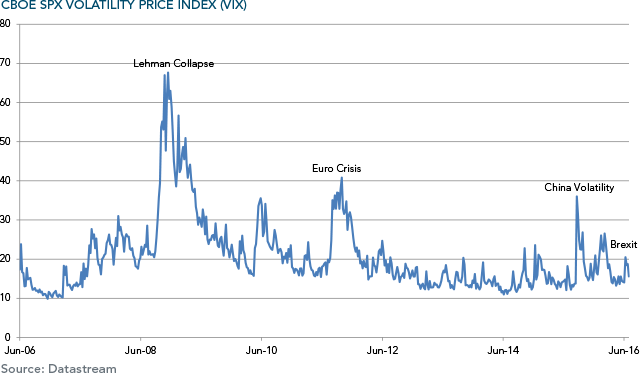
Yes, the Brexit vote did lead to initial volatility in markets, but this has not been exceptional or out of the ordinary. One widely viewed barometer is the Chicago Board Options Exchange’s volatility index or ‘VIX’. Using S&P 500 stock index options, this index measures market expectations of near-term volatility.

2016_CBOE_SPX_Volatility_Price_Index

You can see by the chart above that while there was a slight rise in volatility around the Brexit result, it was insignificant relative to other major events of recent years, including the collapse of Lehman Brothers, the Euro Zone crisis of 2011 and the severe volatility in the Chinese domestic equity market in 2015.

None of this is intended to downplay the political and economic difficulties of Britain leaving the European Union, but it does illustrate the dangers of trying to second guess markets and base a long-term investment strategy on speculation.

Another recent example of this tendency came shortly after the Brexit vote, in the Australian general election, where a much closer-than-expected result sparked media speculation of severe economic and market implications.

In the Sydney Morning Herald, journalists said Australia faced a “protracted political and constitutional crisis”, leaving spooked financial markets on edge, investment stalled and the country’s credit rating on the brink of a downgrade.3

By the end of the first day after the vote, however, Reuters reported that Australian shares had risen as “surging commodity prices” overrode political uncertainty. After a brief blip, the Australian dollar rebounded to where it was before the poll.4

A week later, late counting in the most marginal constituencies gave the incumbent Liberal-National Party Coalition the barest majority in the House of Representatives, allowing them to form a government.

Now the focus of speculation has turned to how markets might respond to the US presidential election. CNBC recently reported that surveys from Wall Street investment firms showed “growing concern” over how the race might play out.5

Given the examples above, would you be wagering your portfolio on this sort of speculation, particularly when it comes from the same people who pronounced on Brexit? And remember, not only must you correctly forecast the outcome of the vote you have to correctly guess how the market will react.

And think about this. Even if you do get it right, what’s to say some other event might steal the markets’ attention in the meantime? The world is complex and unpredictable. No-one really can be certain about anything.

What we do know is that markets incorporate news instantaneously and that your best protection against volatility is to diversify both across and within asset classes, while remaining focused on how you are tracking relative to your own goals.

The danger of investing based on what just happened is that the situation can change by the time you act, a “crisis” can morph into something far less dramatic and you end up responding to news that is already in the price.

Journalism is often described as writing history on the run. Don’t get caught investing the same way.

Politics and Investing

Political news is dominating the front pages right now, with a presidential election in the US, general election in Australia and a referendum in the UK. What does it all mean for markets?

“It promises to be a nervous week for global markets as traders mull over the relative performances of the US presidential candidates. With no clear favourite, the US stock market is unlikely to find any clear direction until the winner is named.”

Does that sound familiar? That line from an article by the Reuters news agency was carried in newspapers around the world. Last week? Last month? No. In fact, that article is from September, 1988 and was about the Bush-Dukakis debates of that year.1

As in the 2016 campaign, that election pitted two non-incumbents against each other as President Reagan completed his requisite two terms. As 1988 began, the New York Times/CBS News Poll talked of a political mood of “drift and uncertainty”.2

This isn’t to imply that every campaign is the same, but it does serve as a reminder that markets regularly navigate political uncertainty. As for supposed “patterns” in election years, research shows 12-month results are strikingly similar to overall averages.3

Of course, the US is not the only country holding national elections or referendums this year. So is Australia, where, again, two party leaders with no experience of leading a campaign are vying for a lower house majority in a race which pollsters say is too close to call.

Prime Minister Malcolm Turnbull, leading the Liberal-National Coalition, and Bill Shorten, leading the opposition Labor Party, are standing on diametrically opposed platforms—the former promising corporate tax cuts and the latter more spending on health and education.

In the Philippines, a new president and self-declared “strongman”, Rodrigo Duterte, has come to power advocating extra-judicial killings to stamp out crime and drugs.

And in the United Kingdom, voters are due on June 23 to cast a ballot in a referendum on whether Britain stays in the 28-member European Union. The UK conservative government has warned voters of a possible recession should they opt for a “Brexit”.

What do all these events mean for equity markets, for government bonds, for commodities and for currencies? Those kinds of questions get a real workout at these times in the financial media, which inevitably finds a wide divergence of opinion from market observers.

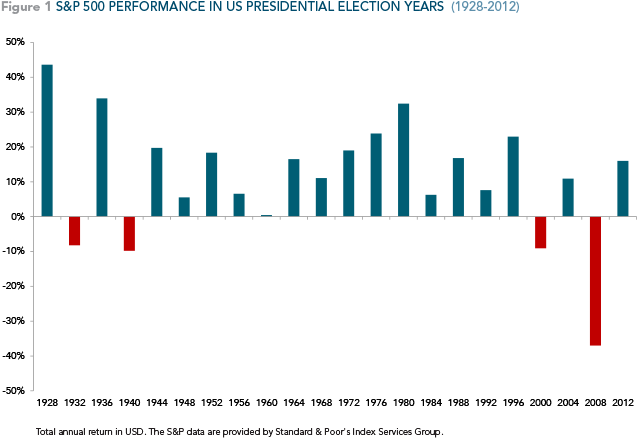
While many people will have a keen interest in political outcomes, academic studies show little pattern in actual market returns during US presidential election years. Figure 1 shows the performance of the S&P 500 in 22 US election years dating back to 1928.


 SP_Perf_in_US_Election_Years

You can see in four of those years, the market fell. In the other 18 instances, it rose. But the truth is this sample size is too small to make any definitive conclusions. And, in any case, it is extremely hard to extract the political from other influences on markets.

For example, the worst annual market outcome during a US presidential year in this sample was 2008 when Democrat contender Barrack Obama defeated Republican nominee John McCain. But if you recall that was also the year of the collapse of Lehman Brothers and the global financial crisis.

Another down year for the market was 2000, the year Republican George W Bush defeated Democrat Al Gore in a tight contest. But that was also the year of the collapse of the bull market in technology stocks, the so-called “tech wreck”.

The point is that any one time markets are being influenced by a myriad of signals and events—economic indicators, earnings news, technological change, trends in consumption and investment, regulatory and policy developments and geopolitical news, to name a few.

So even if you knew ahead of time the outcome of an election in one country, how would you know that events elsewhere would not take greater prominence for the markets?

Keep in mind, also, that elections have a limited range of possible outcomes—a clear win for candidate or party ‘A’ or ‘B’, or an inconclusive result. Markets will adjust ahead of time to deal with risks around these outcomes. And the degree to which they move on the result will often depend on how much it varies from the consensus expectation.

So while we have responsibilities as citizens to take an interest in elections, it is by no means clear that these events have long-term implications for our decisions as investors.

That is much more a matter of our own goals and risk appetites, our investment horizons, the structure of our portfolios, our degree of diversification and the costs we pay.

Living on the Edge

Digital innovation has democratised access to financial information to the point where anyone with a smartphone, a few apps and real-time news and data feeds can be like a pro trader. But who wants to do that? And do you need to?

In the world of information flows, speed is barely an issue anymore. And the old hierarchies, where professionals with state of the art systems had priority access to breaking news, have been progressively dismantled.

For instance, a $500 smartphone with a 1.3 gigahertz processor is more than a thousand times faster than the Apollo guidance computer that sent astronauts to the moon nearly half a century ago. Its internal memory is 250,000 times bigger.

The upshot is that financial and other information comes at us faster and in greater volumes than ever. We no longer have to wait for the six o’clock TV news to know what happened in markets today. Our apps notify us in real time.

But amid this era of always-on news flow, the big question for most of us is not about our access to real-time information; it’s about whether we actually need to be so plugged in to have a successful investment experience.

Dealing with that question starts with reflecting how much of an investment “edge” you get by having access to information that is so freely available.

On that score, there’s an old concept in economics called the law of diminishing returns. It essentially says that adding more and more of one input, while keeping everything else constant, gives you progressively less bang for your buck.

At the industrial end of this technology arms race, you have the high frequency traders who spend a fortune on advanced communications infrastructure to try to take advantage of split second changes in millions of prices. On the evolutionary scale, these computer programs make smart phones look like ploughshares.

So against that background it’s not clear that adding the latest market-minder app to your iPhone is necessarily the path to investment success.

The second question to ask is what you are trying to achieve. Are you trying to “beat” the market by finding mistakes in prices and timing your entry and exit points? If so, and given the competition above, you might want to review your information budget.

The truth for most of us is that investment is not an end in itself, but a means to an end. We want to save for a house or put our children through school or look after aging parents or give ourselves a good chance of a comfortable retirement.

In this context, the most relevant information is about our own lives and circumstances. How much do we spend? How much can we save? What’s our risk appetite? What are our future needs? And how much of a cash buffer do we need?

This is the value an independent financial advisor can bring—not in trying to second-guess the market or using forecasts to gamble with your money—but in understanding the life situation of each person and what each of them needs.

Ultimately, markets are so competitive that we really are wasting our own precious resources by trying to game them. What most of us need is to secure the long-term capital market rates of return as efficiently as possible.

So our limited resource is not speed or access to information, but our own time. We only have a short window to live the lives we want. And that means we should start any investment plan with understanding ourselves.

That’s where the edge is.

The Policy Maze

Along with market ups and downs and media noise, government policy is one of those things that investors can’t control. But a good financial advisor can still help them navigate successfully through a constantly changing environment.

The risks that policy change poses to investors were dramatically highlighted by the recent federal budget in Australia, where a cash-strapped government announced the biggest shake-up in superannuation in at least a decade.

The announcement came just hours after another surprise policy change as the Reserve Bank of Australia cut its official cash rate to a record low of 1.75%, citing unexpectedly lower inflation and further signs of an economic slowdown in China.1

In the budget, the government argued it is seeking to better target tax concessions for superannuation and to bring the system in line with its objective of “providing income in retirement to substitute or supplement the age pension”.2

The changes include:

  • A $1.6 million cap on how much individuals can transfer into retirement accounts
  • The reduction in the income threshold to $250,000 (from $300,000) for paying a 30% (instead of 15%) tax on concessional super contributions.
  • The lowering of the cap on tax concessional contributions to $25,000
  • A $500,000 lifetime cap on non-concessional contributions
  • A superannuation tax offset for people on incomes below $37,000

Many of these measures had been well flagged, but the $1.6 million retirement account cap was a genuine surprise to most observers, as was the RBA’s rate cut. Indeed, news agency Bloomberg reported on the morning of the central bank meeting that 15 out of 27 economists expected no change in rates.3

While the government says the changes in the tax concessions will not affect 96% of superannuation fund members, there clearly will be implications for many more people in the future as they progress to higher incomes.

Others can argue the rights and wrongs of these particular changes, but there is no question that the complexity and flux in superannuation rules highlight the value that an expert, independent financial advisor can bring to individuals and families.

For instance, how can you maximise your retirement income and minimise your tax? What do the changes mean in terms of when you can afford to retire? What tax-effective investment solutions are available to you outside super? If you come into an inheritance or sell a business, what are your options now?

In the case of the rate cut, people may ask about the effect of interest rate changes or inflation on their retirement saving and what strategies are available to ensure they can maintain their consumption as planned.

There are many possible challenges and questions that advisors can deal with at times like these, not only because of the complexity of tax and regulation but also due to the complexity and variability of people’s lives, circumstances, risk appetites and preferences.

And all of this takes a human advisor, as no robot or sophisticated algorithm can be programmed quickly enough to deal with policy changes that come out of left field.

Yes, change can be unsettling and makes many of us anxious. But the unpredictability of government policy, like the unpredictability of markets, will always be with us.

Like a sailing boat skipper who knows how to set the sails to deal with shifting winds and choppy seas, your financial advisor can provide the right combination of structure and flexibility in your portfolio to help you cope with policy change.